
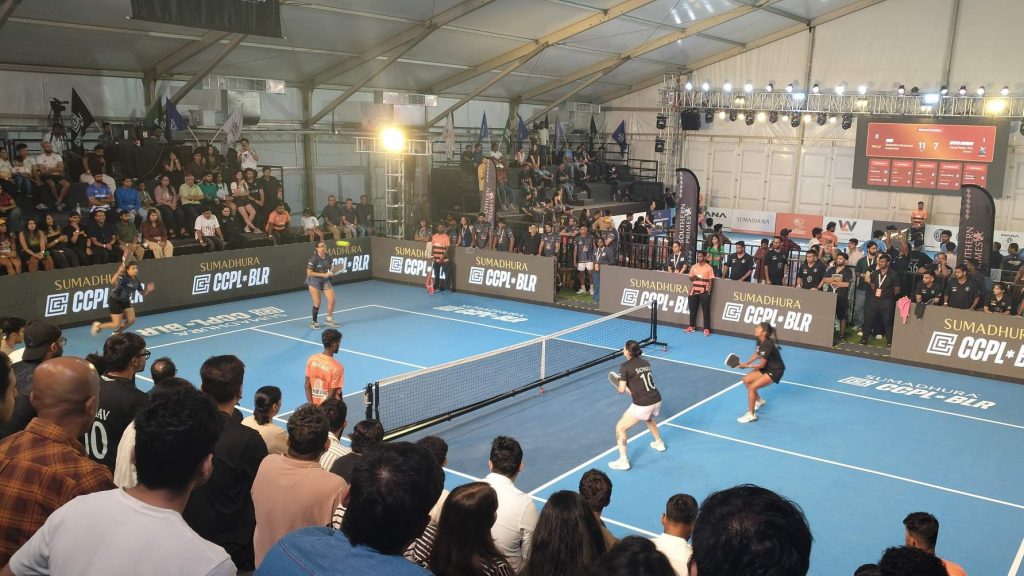
Sharmada Balu struts onto the pickleball court as if to bend it to her will. The floral pop of colour on her hair makes as vivid a statement as the scoreline at the end of the match. Through the game, she remonstrates, she celebrates; fist pumps at her teammates, high-fives with some young fans courtside. Remnants of muscle memory from her other life as a professional tennis player, where she once won gold at the South Asian Games, escape in the odd impatient burst, before she reels in the power and trades it for the lighter touches and tactics pickleball calls for.
Over weekends in April and May, she and her colleagues from six mixed-gender teams competed in the Sumadhura Centre Court Pickleball League in Bangalore.
And I got to watch from the stands—pleasantly surprised at how enjoyable the experience was.
As a fan and journalist, I love watching sports live. But I also find the experience, especially in India, ranging from inconvenient to unpleasant to plain punitive. I’ve been soaked while standing under leaky stadium roofs, gone hungry for a full day’s worth of play and rationed drinking water for want of functioning toilets. I’ve had coins treated as contraband and been separated from my handbag. I’ve waited three hours in the dead of the night for an Uber to take me back to civilization, hitchhiked on highways and told myself that the inappropriate contact in the metro melee must have been accidental. I’ve wondered when I’d feel safe and ready enough to bring my kids to stadiums, because these sports that claim to want to inspire kids don’t really make it easy for kids to share the experience.
The bar was always low. But this new league recalibrated my expectations.
Here, even as I learnt the language of a new sport, developing parasocial relationships with Sharmada, Rishi, Rashein et al, I did so with pizza and avocado nippattu in hand, a drink to wash it down and nobody confiscating my lip balm. Across me in the stands, someone had brought their gentle goldie along for the evening. Kids, exhausted by evening hours on the bouncy castle set up in the hospitality area alongside, nestled asleep into parents’ shoulders. Others, eyes shining even past their bedtime, were enveloped in the addictive embrace of live, community sport.
Here was an example of what a positive sporting experience could be, if we all just gave it a bit of thought.
A ‘good’ sports experience
To be fair, lots of people in sports are wrestling with that question: What makes for a good, sustainable sporting experience?
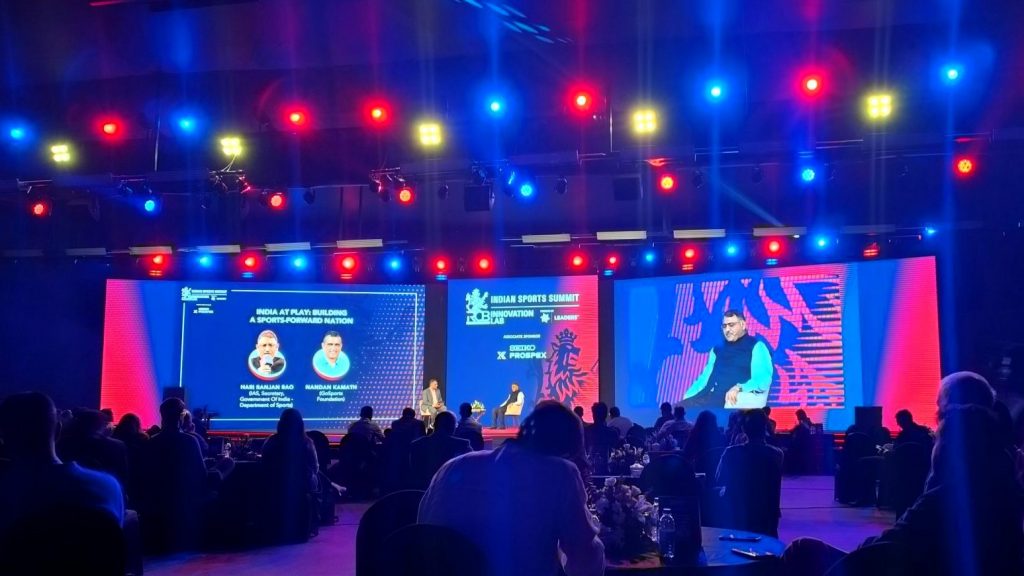
One panel at the RCB Innovation Lab Indian Sports Summit last week, for instance, explored this.
The Bengaluru police, burned by the lives lost in the crowd crush last year during the RCB victory celebrations, emphasised the safety aspect. Seemant Kumar Singh, IPS Commissioner of Police, Bangalore City, said the police wanted people at a sporting event to “come, enjoy and go”, rather than just “come, see and go”; a happy crowd, he said, was a more predictable one, making law enforcement easier.
Specifically about the M Chinnaswamy cricket stadium in the city centre, C Vamsi Krishna, Joint Commissioner of Police (West), explained that by working with Namme Metro, the authorities could clear the stadium and the surrounding area in just around 35 minutes now, as compared to the couple of hours it took earlier.
Ryan Sickman of Gensler, a global design firm responsible for several big-ticket sports projects worldwide, highlighted how the live sporting experience is not just about the stadium size, facility and aesthetics, but starts from understanding the wider locality and city, the needs and identity of the local community.
Paul Foster, CEO of One Plan, which helps bodies plan sports events, pointed to the trend towards getting people to spend more time in stadiums or at events for better fan experiences and revenue generation. He spoke of the importance of understanding the nature of the audience expected and rewriting the playbook accordingly.
After all, live sports have largely been designed for majority male audiences. But when more women and children are expected, that will have to be reflected in, for example, new bag policies, different food and beverage options, inclusive spaces and toilets. I don’t know about similar numbers in the Indian context, but in 2025, the “Design Guidelines for the Delivery of Elite Women’s Stadiums in England” shared by WSL Football suggested moving toilets “from 80%/20% male/female to 45%/45%, with gender neutral facilities to be available (10%)” to reflect the nature of the audience for women’s sports.
Building a culture
Which brings me back to the Centre Court Pickleball League experience. This tournament is no IPL and the 1500-or-so people that showed up on the weekend aren’t the same as the 40,000 at a cricket match the panel was talking about. Several local sports events pop up around the country, able to draw hundreds without trying too hard.
But on the scale in which it existed, its ambition, its format, the athletic ability and competition on display, as well as the quality of its execution, means CCPL stands out.
The league was optimised for fan experience and community, not for TV audiences and big crowds. And in making me choose to watch a sport on a Saturday evening, rather than go to a restaurant for that pizza, it touched on that other promised land in sports discourse: a chance to participate in sports culture.
Perhaps, in this, the nature of pickleball serves the cause well. Growing fast, pickleball sits at the intersection of sports and community. A Swiggy Scenes 2025 report suggested it was a rising “social format”, offering a low-pressure environment to mingle. (Swiggy owns a team in the World Pickleball League, no relation to this one, so you understand their interest.)
And it has arrived when sports in the country is having a Moment. Recent years in Indian sport have seen a shift from a focus on high performance, along with bandaid treatment at the grassroots, to an understanding that the bridge between the two is a strong sporting culture. Global excellence in terms of medals is not the sole aim: The new Khelo Bharat Niti 2025 takes a broader view of promoting sports, with “national building” at the heart of its vision. It looks to “harness the power of sports for nation’s holistic development … and [make] sports a people’s movement for health and well-being.”
“Sports offer a valuable source of leisure and entertainment, enriching lives and enhancing quality of life,” it declares.
So, encountering a sporting experience that reflects this and also goes on to promote the sentiment feels like one worth paying attention to. And perhaps one day, a fun Saturday evening watching pickleball will feed into a Sunday morning playing it.