
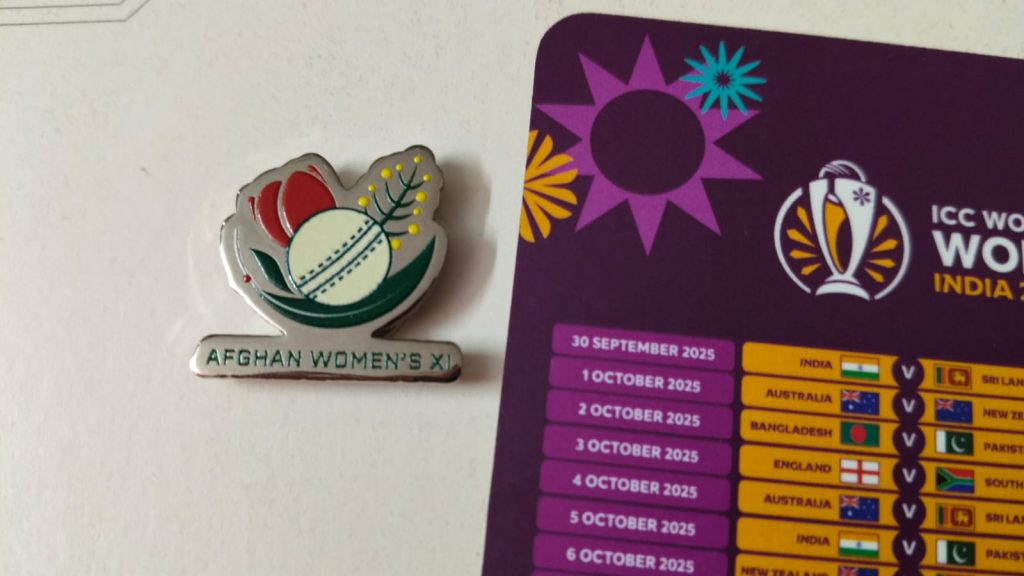
Among the shiny baubles I own, this lapel pin feels especially meaningful.
On it, a red tulip and a wispy sprig of what I would later learn is a golden wattle flank a cricket ball cradled within a green leaf. Below, etched in quiet dignity, is: “Afghan Women’s XI”.
Nahida Sapan, the captain of this team, pinned it on me. And I’m honoured to wear it.
The tulip, the national flower of Afghanistan, and the golden wattle, the floral emblem of Australia, are symbols of the worlds these women today straddle. Their dream of sport was born in Afghanistan. Australia, where they fled to after the Taliban takeover of their country, is where their dream lives on. Cricket is the symbol of their resilience, a vehicle for their dreams, and a platform for their voices against gender injustice.
This crest is not that of the official Afghanistan women’s cricket team. Because there is none. That idea ended when the Taliban with their extremist views on women in public life returned to power and has found little fuel for revival on international platforms.
This month, female Afghan footballers, similarly mostly in exile in Australia, are playing historic friendlies as the Afghan women’s refugee team, recognised and supported by FIFA. They are playing as ‘Afghan Women United’. Such international playing opportunities haven’t yet come by for the cricketers. ‘Afghan Women’s XI’ is as close as it gets for now.
These XI are part of the group of 25 contracted by the Afghanistan Cricket Board back in 2020, who were preparing to play their first T20 international. While a few of these contracted players escaped to Canada, a majority found new homes in Australia, thanks to the efforts of a number of individuals, rights organisations and governments.
The ICC for their part, in April this year, set up a fund to “ensure the players have the resources they need to keep pursuing the game”. They promised “coaching, access to world-class facilities and personalised mentorship” and later “key engagement opportunities at ICC events”. There isn’t yet a pathway towards playing international matches.
So it is that Nahida and her team were in India on the sidelines of the ICC Women’s World Cup 2025. They trained at the BCCI Centre of Excellence, interacted with athletes of some of the top participating teams, attended the opening game of the World Cup – and perhaps understood what it is like to be a part of an international sports team.

I got to attend a dinner to welcome them to Bangalore, organised by the Australian Consulate-General in Bengaluru. It was a chance to get together to celebrate their remarkable journey, and also recognise the power of sport to change lives. These women bore a heavy past, but the future carried hope. We spoke about their schools, their careers, their ambitions, the little kid travelling with the team who’d just woken up from a nap …
And it made for a reassuring reminder. When the world is burning, it’s sometimes hard to see the point of large sporting events and care about who was bowled by whom for how many runs. But then you remember that it’s in making space for dreams that we find the power to counter dark moments in history.
We play sport to soar, to break out of the boxes we get put in, to celebrate the best in humans, even in an era when we are faced with evidence of some of our worst impulses. That should be the point of this Women’s World Cup; that is what this Afghan Women’s XI stand for.
Having said that, the presence of Afghan athletes at this World Cup shouldn’t be a token. It continues to be a sobering reminder of the work still to be done in opening women’s cricket for all.
This World Cup is being held at a time when women’s sport is in its best health. Women’s cricket in India, particularly around the Women’s Premier League, has shattered records for audience numbers and team valuations, and raised the bar for ad rates, sponsorship numbers and simply even the creative potential of marketing in women’s sports. And all those decades of debate about equal prize money seem quaint when we learn that the prize money in this Women’s World Cup is more than what the men got last year in the event in India.
Among the less tangible markers of progress: Every on-field success is not seen as the golden ticket to suddenly turbocharging the sport in the country. Athletes aren’t having to constantly prove themselves as worthy of attention or money or professionalism or investment. They don’t carry the burden of securing the future of their sport – that work is done.
But in celebrating these wins – and we must indeed celebrate them – we forget that it is not true for all women, and not in all countries, not even in all countries playing this World Cup. A platform has been offered for women’s dreams, now we should create paths for more women, in more places, to realise those dreams, and thrive.